What Are the Benefits of Loose Parts Play?
The benefits of loose parts play come from what children practise: making decisions, testing ideas, moving materials, and trying again. These are opportunities, rather than guaranteed outcomes from a particular basket.
Inventing uses instead of following a finished model.
Changing a base when a structure keeps falling.
Grasping, placing, and turning age-appropriate pieces.
Carrying larger pieces and judging manageable loads.
Comparing sizes, counting, and giving each space one object.
Testing balance, weight, shadows, and material properties.
Discovering what changes when they push, tip, or rearrange.
Describing textures, explaining plans, and telling stories.
Sharing resources and negotiating different ideas.
Returning to an interesting challenge at their own pace.
Choosing what to attempt and when to change direction.
What Counts as a Loose Part?
Good loose parts materials offer different textures, weights, shapes, and possibilities, while remaining safe for the child using them. Start by looking around your home.
Smooth stones, sturdy sticks, intact pinecones, and large shells.
Blocks, bowls, spoons, rings, and smooth coasters.
Washable cloth squares, felt, and small blankets.
Measuring cups, muffin tins, colanders, and sturdy cardboard.
Baskets, trays, lightweight bowls, and boxes.
Exclude small objects for under-threes and any child who mouths materials. Corks, beads, buttons, small lids, and small natural finds belong only in an appropriately supervised older child's collection. Avoid cords and loop-forming ribbons for younger children.
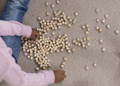
Choose things that stack, roll, drape, and fit inside each other. Variety matters more than quantity. Six interesting pieces can do plenty.
With any open-ended toy set, follow its age guidance and assess every component.
How Do You Set Up Loose Parts Play at Home?
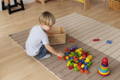
Start loose parts play at home with one tray, three material types, and a clear place to play. You can add more when your child shows you why.
- Make an invitation. Put bowls, large blocks, and fabric neatly together. A welcoming Montessori play area doesn't require a room makeover.
- Define the space. A mat or tray helps show where materials belong. This works in a shared room or a preschool playroom.
- Make storage reachable. Use stable baskets or lightweight containers children can manage. Save glass jars for adult storage.
- Rotate when interest fades. Toy rotation means swapping, rather than continually adding.
- Finish by returning materials. Cleaning up the Montessori way becomes part of the activity when each category has a home.
- Care for the collection. Check damage regularly and clean wooden toys appropriately, following their care instructions.
Combine the basket with existing figures or blocks. Your living room has enough accessories.
How Do You Keep Loose Parts Play Safe?
Safe loose parts play starts with suitable materials, close supervision, and adjustments for the youngest child who can reach them.
- Under three or still mouthing: exclude small parts, fragile finds, and pieces that can crumble or detach. Supervision doesn't make a choking hazard suitable.
- Every material: check for sharp edges, splinters, mould, flaking paint, and trapped fingers. Exclude magnets and batteries.
- Natural finds: identify them, clean appropriately, and dry thoroughly. Skip toxic, spiky, contaminated, or unknown items.
- Mixed ages: make shared floor play suitable for the youngest child. Keep older children's small pieces physically inaccessible, including during cleanup.
- Water: stay within arm's reach throughout and empty the basin immediately afterward.
- Heavy pieces: keep them low, teach two-handed carrying, and supervise. Only climb on equipment designed for it.
Choose non-toxic materials, but remember that finish, size, condition, and intended use all matter.
30 Loose Parts Play Ideas by Age
These loose parts activities are invitations. Your child may ignore your excellent bridge proposal and spend twenty minutes filling a bowl. That's still play.
Choose by abilities and mouthing habits, and stay present. Small materials are unsuitable for under-threes or any child who mouths objects, regardless of the activity's label.
Babies 6-12 Months: Grasp, Explore, Repeat
For babies, offer a few large, age-appropriate objects to explore with you nearby. Montessori toys for babies and materials in the 0-12 months collection should match their current abilities.
Offer a baby-rated sensory ring with securely attached fabric textures, rather than tying loose ribbons to a basket. Let your baby turn, grasp, and release it.
What it builds: Grasping and tactile exploration.
Use intact, oversized lids from age-rated baby containers and a wide plastic bowl. Let your baby drop them in and help tip them out; skip household metal lids.
What it builds: Release, wrist movement, and cause and effect.
Place two lightweight bowls beside three large, baby-rated rings. Moving even one ring between them is enough.
What it builds: Hand-eye-mouth coordination and hand-to-hand transfer.
Tuck a short, wide washcloth partly through a smooth, wide opening in a baby-safe basket. Keep it loose enough to pull free, without ties or loops.
What it builds: Grasping and persistence.
Offer two large, baby-rated grasping toys of different, manageable weights. Let your baby lift each; avoid stones, ordinary corks, and weighted homemade objects.
What it builds: Exploring effort and material differences.
Offer three intact baby-safe cups or bowls made from different materials. Let your baby tap them with an open hand and listen.
What it builds: Sound comparison and cause and effect.
Toddlers 1-2 Years: Fill, Carry, Post
Loose parts play for toddlers often centres on moving things somewhere else, repeatedly. Choose toddler materials and toys for one-year-olds with large, sturdy components.
Cut wide slots into a sturdy cardboard box and offer oversized, smooth discs. Remove staples and replace the box if chewing damages it.
What it builds: Hand-eye coordination and spatial judgement.
Place large, lightweight parts beside a small basket and leave a clear route to another corner. Expect enthusiastic deliveries.
What it builds: Purposeful movement and two-handed carrying.
Offer a smooth muffin tin and large age-appropriate rings to distribute. Keep every piece too large to be a small-parts hazard.
What it builds: Sorting and sequencing and early one-to-one correspondence.
Set out large, flat blocks and sturdy coasters without cork backing. Let your toddler discover which combinations stay upright.
What it builds: Balance and trial and error.
Offer a small blanket and a stable, low box to cover and uncover. Keep fabric away from the face and neck, with no enclosed hiding spaces.
What it builds: Spatial awareness and early pretend play.
Place large floating bath-toy lids in shallow water. Stay within arm's reach while your toddler pushes and gathers them; empty afterward. Brief activities for one-year-olds count, too.
What it builds: Wrist control and floating exploration.
Toddlers 2-3 Years: Sort, Connect, Experiment
Two-year-olds may begin combining materials with a plan, while still needing large pieces. Follow their developmental interests when choosing materials for age two.
Lay a wide blue fabric strip flat and offer large coloured blocks to place alongside it. No long yarn or ribbon needed.
What it builds: Colour and shape recognition and grouping.
Place two blocks apart with broad, smooth pieces nearby. Let your child experiment with connecting the gap.
What it builds: Early engineering and spatial reasoning.
Offer large, clean, identified natural objects that don't crumble, splinter, or pose a small-parts hazard. Let your child invent the groups.
What it builds: Sorting and matching, observation, and autonomy.
Provide fabric squares and large blocks to fold into parcels and uncover. Skip cords and tied bundles.
What it builds: Fine motor control and sequencing.
Swap cut-open tins for sturdy lightweight cups and broad cardboard discs. Build at floor level, then clear space for the inevitable collapse.
What it builds: Balance and cause and effect.
Arrange large parts on the floor in sunlight or under a cool LED light controlled by you. Move one piece and watch its shadow change.
What it builds: Observation and descriptive vocabulary.
Preschoolers 3-4 Years: Patterns and Stories
Loose parts play for preschoolers can grow into patterns, experiments, and pretend worlds. Choose toys for three-year-olds and preschool materials around those interests, keeping small pieces away from children who mouth them.
19. Small-World Landscapes
Offer fabric fields, large smooth stones, and sturdy sticks beside existing animal figures. Let your child decide who lives where.
What it builds: Storytelling, language, and symbolic thinking.
Begin a block-ring-block-ring sequence and leave more pieces nearby. Your child might continue it or invent another rhythm.
What it builds: Pattern recognition.
Prop sturdy cardboard securely at a low angle. Offer age-appropriate round and flat objects to investigate what rolls or slides.
What it builds: Prediction and experimentation.
22. Loose Parts Portraits
Offer a tray and assorted suitable shapes for a temporary face or figure. No glue means the eyebrows can change their mind.
What it builds: Creative play and revising ideas.
23. Measuring With Things
Line identical large blocks along a cushion to see how many fit. Model putting them end to end without gaps.
What it builds: Counting and non-standard measurement.
Group some parts by a visible feature and invite your child to guess the rule. Then swap roles. Innovative play for three-year-olds often starts with familiar materials used differently.
What it builds: Logic and communication.
Ages 4-6: Plan, Test, Explain
Older children can plan projects and explain their choices. Combine familiar parts with materials for older children, four-year-olds, or five-year-olds, according to readiness.
Invite your child to sketch something before building it. Compare the two without treating the drawing as a contract.
What it builds: Planning and flexible thinking.
Build a low tabletop tower and test it with one gentle tap. Change one feature before trying again.
What it builds: Engineering and persistence, much like practical brainteasers.
27. Letter and Number Forms
Offer smooth sticks or blocks to arrange into familiar letters and numerals. Smaller pieces are only for children who no longer mouth objects, away from younger siblings.
What it builds: Symbol recognition and some school-readiness skills.
Take turns adding an object to a line and a sentence to a story. The wooden spoon may get a surprisingly dramatic backstory.
What it builds: Narrative and turn-taking.
29. Sorting Into Families
Invite your child to group materials by their own system and explain it. “Things that wobble” is a perfectly respectable category.
What it builds: Classification and reasoning.
30. Obstacle Course Build
Let your child arrange firm cushions, floor markers, and suitable movement equipment into a low route; check stability before use. Purpose-designed Montessori Balance Beams & Stones can offer rearrangeable elements within their use instructions.
What it builds: Gross motor planning and ownership.
How Can You Support Without Taking Over?
Prepare the materials, stay available, and give your child time to decide what happens next.
The balance between doing it for them and letting them do it can be tricky when you can see exactly why the tower falls. Wait, unless safety requires you to intervene.
Try these responses:
- Notice effort: “You tried three different bases.”
- Invite explanation: “Tell me about this part.”
- Offer help without grabbing: “Would you like a hand?”
- Allow silence: Concentrating children don't need commentary on every block.
You can join in when invited. Parallel play, making your own arrangement nearby, gives younger children company without taking ownership of theirs.
When playing at home with a toddler, expect repetition, wandering off, and mixing collections. Keep sensible boundaries, but let the wooden rings visit the animal basket. They'll survive the trip.
Can Loose Parts Play Happen Beyond the Living Room?
Loose parts work outdoors, on trips, and between siblings when you adapt materials and boundaries to the setting.
- Outside: Combine outdoor play with suitable natural finds. Take only what local rules permit; existing outdoor toys can supply containers and bases.
- At the beach: Add Montessori beach activities using sand, broad shells, and containers. Keep small shells away from under-threes and mouthing children, with close water supervision.
- On trips: Pack a small pouch of suitable parts with road-trip companions. When travelling with Montessori toys, choose travel materials that are easy to count back in.
- Across seasons: Change textures and colours alongside seasonal play, without gathering more than you can store.
- With siblings: Shared play and toys siblings can enjoy together work best when everyone's materials are safe for the youngest participant.
How Do You Build a Balanced Montessori-Inspired Shelf?
A balanced shelf offers a few purposeful challenges, some open-ended materials, and opportunities to move.
Think in three groups:
A puzzle, matching task, or purposeful material
Offer a clear challenge and opportunities for mastery.
Leave space for invention and experimentation.
Suitable movement materials
Invite carrying, balancing, and whole-body activity.
Skills can travel between them. A child exploring shapes in matching work may notice those shapes while building. A child accustomed to trying alternatives may bring that persistence to a puzzle.
When evaluating Montessori toys, consider what they let your child do. Montessori-aligned materials need more than a wooden finish, and open-ended sets aren't automatically classic Montessori apparatus.
If you're choosing an addition, the Toy Quiz and Montessori toys by age can help narrow the options. Start with the child's interests and what is already working.
The Box, the Basket, and the Child
Loose parts play takes ordinary exploration seriously. The box left plenty undecided.
A collection grows with your child, from grasping to building and storytelling, alongside purposeful Montessori materials.
Choose one safe invitation. Leave room for your child's version.
Put a few things in a basket. Set it down. Stay nearby, and see what happens.
Frequently Asked Questions









 Secure CheckoutWorld’s most secure payment method