Why Movement Matters in Montessori: Balance, Coordination, and the Thinking Body
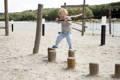
A child steps onto a narrow beam, spreads both arms, and stares fiercely at their feet. Their tongue may even appear because, apparently, balance requires maximum facial involvement.

They wobble, recover, and take another careful step. The floor is lava, the sofa is a rescue station, and this mission is extremely serious.

It looks like play because it is play. But there’s much more going on here.

The child is coordinating muscles, reading signals from their body, judging distance, correcting movement, controlling impulses, and maintaining intense concentration. Their brain and body are working together to solve a real problem.

This is why Montessori movement is a big part of learning.

Through walking, climbing, carrying, balancing, pouring, jumping, and building, children develop the physical control that supports independence and focused work. Gross-motor play can also strengthen posture, body awareness, confidence, and the ability to plan a sequence of actions.

Let’s look at why movement matters in Montessori, what balance activities for kids genuinely develop, and how parents can create meaningful movement opportunities at home, even when the weather has decided that nobody is going outside.
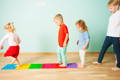
Children walking barefoot across colourful textured sensory mats during an indoor balance activity.

Why Is Movement Important in Montessori Education?

Movement is important in Montessori education because children learn by actively using their bodies, senses, and minds together.

Maria Montessori rejected the idea that a child must sit still to learn properly. She observed that movement supports intellectual development and gives children a practical way to explore their abilities and environment.

Montessori wrote that “movement, or physical activity, is thus an essential factor in intellectual growth.” In other words, the body is not simply the vehicle that delivers the brain to the classroom. It is part of the learning system.

This connection appears throughout the Montessori day. A child can:
  • Carry a tray carefully across the room
  • Roll and unroll a work mat
  • Pour water between small pitchers
  • Move a chair without dragging it
  • Wash a table using controlled circular movements
  • Return materials to the correct shelf
These activities may not look like a PE lesson, but they require balance, strength, planning, coordination, and concentration. Movement has a purpose, and the child controls it independently.

This reflects the wider Montessori principles of freedom within limits, hands-on learning, repetition, and respect for the child’s natural development.

The Cleveland Clinic explains that gross motor development includes large-muscle movements such as walking, jumping, climbing, and throwing. It also notes that ordinary Montessori classroom tasks, including lifting, pouring, scrubbing, and walking along a line, involve gross motor control.

That is the key distinction. Montessori movement is not random activity arranged simply to exhaust a child before bedtime, although parents may consider that a charming bonus. It is purposeful activity that supports control, independence, and confidence.

Parents can explore more practical examples in these gross motor activity ideas.

What Is Walking on the Line in Montessori?

Walking on the Line is a classic Montessori activity in which children follow a marked line or ellipse to practise balance, coordination, concentration, and controlled movement.

The line is commonly painted or taped onto the classroom floor. Children walk around it slowly, often placing one foot directly in front of the other. Once this becomes comfortable, the guide may introduce a new challenge, such as carrying a bell, balancing an object, walking to music, or changing pace.

The exercise is simple, but the work is considerable. A child must control their speed, position their feet, maintain personal space, follow the curve, and correct each wobble without abandoning the mission.

Maria Montessori observed that children naturally seek narrow or difficult paths. Give a child a wide pavement, and they may immediately choose the curb. Show them a fallen log, and suddenly the ordinary ground is unacceptable.
Young child practising balance by walking along a narrow textured path outdoors.
So, walking on the line develops control and coordination. Its elliptical shape adds curves and direction changes, while variations such as marching, skipping, or carrying an object create fresh challenges.

Walking on the Line Montessori activities also encourage:
  • Deliberate rather than rushed movement
  • Awareness of other people
  • Persistence after losing balance
  • Control of the arms, feet, and torso
  • Concentration over a complete movement cycle
It is a neat demonstration of the Montessori view: the child is not moving instead of learning. The child is learning through movement.

What Are Gross Motor Skills?

Gross motor skills are the abilities children use to control the large muscles in their torso, arms, and legs during whole-body movement.

Walking, running, crawling, climbing, throwing, jumping, and balancing all depend on these skills. Gross motor development begins early and continues as children gain strength, coordination, and greater control over increasingly complicated movements.

Fine motor skills involve smaller, more precise actions, such as turning a page, fastening a button, or holding a pencil. However, the two areas are connected. A child needs a reasonably stable shoulder, torso, and sitting position before the hands can work comfortably and precisely.

That is why gross motor skills in Montessori environments are supported alongside fine motor skills. One does not replace the other. They work as a team, although the legs are usually louder about it.

What Do Balance and Gross-Motor Play Build?

Balance and gross-motor play build physical control, body awareness, motor planning, concentration, and confidence.

Here is what children are practising while they walk, hop, climb, crawl, and wobble their way through a challenge:

Developmental Area

What the Child Is Doing

Why It Matters

Balance and coordination

Adjusting the body after each movement

Supports controlled walking, running, climbing, and everyday physical confidence

Core strength and posture

Stabilising the torso while moving

Helps the child sit, reach, carry, and use their hands from a steadier position

Body awareness

Sensing where limbs are without constantly looking

Supports smoother, safer, and more controlled movement

Motor planning

Deciding how to cross a path

Builds sequencing, flexible thinking, and physical problem-solving

Focus and self-regulation

Slowing down and controlling impulses

Helps the child stay with a demanding task

Confidence

Attempting, wobbling, and trying again

Teaches the child that difficulty can be managed

Balance and Coordination

Balance and coordination allow children to organise several parts of the body into one controlled action.

Crossing a stepping-stone path, for example, requires the child to judge distance, shift weight, lift one foot, place it accurately, and prepare for the next step. The brain receives feedback after every movement and makes small corrections.

These balance and coordination activities build the foundations children use during running, dressing, stair climbing, playground games, and sport.

Core Strength and Posture

Core strength gives the child a stable centre from which the arms and legs can move.
A stable torso supports everyday tasks such as sitting upright, carrying objects, reaching across a table, and controlling a pencil. Balance activities naturally involve the core because the body must repeatedly correct its position.

This does not mean five minutes on a beam will transform handwriting overnight. Child development is less like pressing a button and more like making soup. Many ingredients work together, and it takes time.

Vestibular and Proprioceptive Awareness

The vestibular and proprioceptive systems help children understand movement, balance, and the position of their bodies.

The vestibular system, located in the inner ear, responds to head movement and changes in position. The proprioceptive system uses information from muscles and joints to help the brain understand where the body is and how much force it is using.

This is why vestibular activities for kids often involve movement in different directions, while proprioceptive play may include pushing, pulling, carrying, climbing, or crawling.

Together, these systems contribute to body control and spatial awareness in toddlers.

Motor Planning and Problem-Solving

Motor planning is the ability to imagine, organise, and perform a physical action.
When a child sees a zigzag course, they must decide where to begin, which foot to use, how far to step, and what to do at a corner. If their first plan fails, they adjust it.

That is problem-solving in physical form. No worksheet required.

Confidence and Healthy Risk-Taking

Balance play gives children manageable opportunities to attempt something difficult and recover from mistakes.

A low beam or carefully arranged obstacle course allows a child to test their abilities without facing unreasonable danger. They learn to judge distance, notice uncertainty, slow down, and decide whether they are ready for the next challenge.

Confidence grows from genuine experience. It comes from thinking, “I nearly slipped, fixed it, and kept going,” rather than hearing an adult announce “Good job!” before both feet have left the carpet.
Young child holding a rope while balancing across wooden stepping posts at an outdoor playground.

How Does Balance Support Attention and Learning?

Balance supports attention by helping children develop the body control needed to manage movement without directing all their mental energy toward staying organised and upright.

The vestibular system provides the brain with information about movement and orientation. The proprioceptive system provides information about muscles, joints, force, and body position. 

Together, they contribute to core stability and coordinated movement.

For example, classroom work can require a child to:
  • Keep the torso stable while moving the hand
  • Coordinate the eyes and hands
  • Track information from left to right
  • Use both sides of the body together
  • Maintain a comfortable upright position
When a child must consciously manage every part of their posture, less attention may be available for the task in front of them. As balance and body awareness become more automatic, movement demands less deliberate effort.

The claim needs sensible limits. Balance play does not teach a child to read, and a beam is not a substitute for books, conversation, instruction, sleep, or professional support where needed. Instead, movement helps build some of the physical foundations that make focused learning possible.

This body-brain relationship is also part of the broader science behind Montessori toys. The most useful materials invite children to act, notice, adjust, and repeat.

How Does Purposeful Movement Differ From Exercise?

Purposeful movement gives the child a meaningful goal, while exercise may focus mainly on repeating a physical action.

Both can be valuable. The Montessori difference is that movement is usually connected to choice, concentration, independence, or a practical outcome.

A child might carry a tray because it belongs on another table. They may walk slowly because they do not want the water in a cup to spill. They may build a balance path because the sofa has become a castle and only one safe route remains.

The movement has a reason.

This approach also makes space for child-led learning in Montessori education. Instead of completing one course arranged by an adult, the child can design a zigzag, a loop, a short beginner route, or a mighty dragon bridge with surprisingly strict crossing regulations.

Reconfigurable open-ended toys work particularly well here. They do not dictate one correct game. The child becomes both architect and athlete, setting a challenge that feels achievable but still interesting.

Which Balance and Movement Activities Can You Set Up at Home?

Parents can support Montessori gross motor activities at home with tape, cushions, music, trays, and other simple household items.

You do not need a miniature gym in the living room. Try these indoor gross motor activities when outdoor play is difficult, or your child simply needs something purposeful to do.

Tape-Line Tightrope

Place painter’s tape on the floor in a straight line, curve, or ellipse. Invite your child to walk heel to toe without stepping away from the tape.

To add difficulty, ask them to walk backwards, carry a beanbag, or pause at marked points. This is a simple home version of Walking on the Line.

The Floor Is Lava

Arrange firm cushions or safe stepping spots across the floor. Let your child plan a route without touching the “lava.”

Change the distance between the spots as their confidence grows. Keep everything low and place the course away from hard furniture, sharp corners, and stairs. Lava is dramatic enough without a trip to urgent care.

Carry and Balance

Ask your child to walk along a line while carrying a small tray, soft toy, or partly filled cup. Begin with something light and unbreakable. Carrying an object changes the child’s centre of balance and encourages slower, more controlled movement.

Animal-Walk Course

Create stations for bear crawls, crab walks, frog jumps, and slow elephant steps.
Animal walks use the arms, legs, shoulders, and core together. They are also ideal for children who reject “exercise” but are perfectly willing to become a bear in the kitchen.

Freeze and Balance

Play music and let your child dance. Pause the music and ask them to freeze with one foot raised.

Keep the pauses unpredictable. The game combines balance, listening, impulse control, and plenty of suspicious adult DJ behaviour.

Design-Your-Own Course

Offer safe materials and let your child arrange the route.

They might create:
  • A short straight path for careful walking
  • A zigzag with sharp turns
  • A loop to complete three times
  • Separate spots for hopping
  • A route that must be crossed while carrying treasure

The Montessori role of the adult is to prepare a safe environment, demonstrate when necessary, and then step back. These ideas fit easily into a broader Montessori at home routine.
Young boy practising balance in a one-legged yoga pose at home.

How Do Wooden Stacking Stones Support Child-Led Play?

Wooden stacking stones support child-led play by letting children decide what to build, test their own ideas, and discover how balance works through hands-on experimentation.

The Montessori Wooden Stones include 21 colourful pieces in different shapes and sizes. Unlike uniform building blocks, their uneven surfaces require children to look closely, rotate pieces, adjust their grip, and find a stable position.

Sometimes the tower stands proudly. Sometimes gravity offers immediate and rather noisy feedback.

That trial-and-error process is the real work. Children can stack the stones vertically, arrange them by colour or size, create miniature sculptures, build pretend landscapes, or invent a structure that appears to defy both logic and basic engineering principles.

While balance beams involve whole-body coordination, stacking stones explore the same basic ideas on a smaller scale. Children investigate weight, position, stability, and cause and effect using their hands and eyes.
Play with wooden stones can support:
  • Fine motor control and precise hand movements
  • Hand-eye coordination
  • Visual and spatial awareness
  • Patience and concentration
  • Logical thinking and problem-solving
  • Creativity and imaginative play
  • Independence through self-directed experimentation

The stones also provide a simple introduction to early STEM thinking. A child may notice that a broad piece creates a more stable base, that an angled surface changes the direction of a tower, or that placing too much weight on one side causes the entire creation to tumble.
Montessori Wooden Stones
No formal physics lecture is necessary.

Product Detail

Verified Specification

Recommended age

3+

Pieces included

21 wooden stones

Material

Eco-friendly wood with non-toxic paint

Size

8.4 × 5.6 × 1.8 inches

Weight

13.9 oz

Play possibilities

Stacking, sorting, building, counting, and imaginative play

Care

Clean with mild soap and a damp cloth, then dry immediately

Important care note

Avoid prolonged contact with liquids

Open-ended materials work well in a Montessori-inspired environment because they do not prescribe one finished result. A child can begin with a simple two-stone stack, attempt a taller tower, sort the pieces, build a colourful arch, or create an entire rocky kingdom with its own complicated laws.

Why Do Balance Beams Make a Lasting Gift?

Balance beams make a lasting gift because children can rearrange them, invent new games, and adapt the challenge as their coordination improves.

Many toys arrive with great ceremony, enjoy one glorious afternoon, and then retire beneath the bed. Open-ended movement equipment has a better chance of earning its space because it does not depend on one script.

One day it is a bridge. The next day it is a mountain path, a pirate escape route, or the only safe road through a living room full of invisible crocodiles.

This makes the Montessori Balance Beams & Stones particularly suitable for:
  • Third birthdays and later milestones
  • Holidays and family celebrations
  • Rainy-day indoor movement
  • Active, screen-free family play
  • High-energy children who enjoy physical challenges
  • Siblings or friends who like designing courses together
Grandparents looking for a substantial gift can also use the principles in this guide to choose something active, durable, and developmentally appropriate. Our guide to Montessori for grandparents offers more help without requiring anyone to memorise the entire Montessori curriculum before breakfast.

How Can You Support Movement Without Hovering?

You can support movement without hovering by preparing a safe challenge, staying close enough to protect your child, and allowing them to solve manageable problems independently.

Try the following Montessori-friendly approach:
  • Follow the child’s lead. Let them choose the route, pace, and imaginative rules.
  • Begin simply. Use a short course, smooth surfaces, and small distances.
  • Stay available. Supervise and be ready to spot when genuinely necessary.
  • Limit physical assistance. Allow the child to find their own centre of balance.
  • Permit appropriate risk. A safe wobble teaches more than an adult immediately lifting the child across.
  • Allow repetition. Children refine movement by trying the same action many times.
  • Notice effort. Comment on patience, adjustment, and recovery rather than only reaching the end.
You might say, “You slowed down at that corner,” or “You caught your balance and tried again.” These observations help the child notice their own process.

Avoid giving constant directions such as “Left foot, arms out, careful, slower, watch the stone, no, the other foot!” Apart from being exhausting for everyone, too much coaching can replace the child’s problem-solving with the adult’s instructions.

There is still room for connection. Playing together can build trust and shared joy. Just remember that joining the play does not require becoming its chief executive.
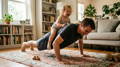
Laughing toddler riding on her father’s back during active play at home.

Let Them Wobble

Movement matters in Montessori because the body and mind develop together.

When children walk a line, balance on a beam, carry a tray, or design an obstacle course, they are doing more than exercising. They are coordinating movement, solving problems, judging risk, regulating speed, and building confidence through experience.

Whether the equipment is painter’s tape, sofa cushions, a fallen log, or a reconfigurable beam-and-stone set, the principle remains the same: offer meaningful movement, make the environment safe, and allow the child to work.

Then watch that familiar scene. Arms out. Eyes focused. One careful foot in front of the other. The child may only see lava below, but you can see a body and brain learning to work together.

Frequently Asked Questions

Why Is Movement Important in Montessori Education?

Movement is important in Montessori education because purposeful physical activity supports coordination, concentration, independence, and active learning. Montessori children use movement throughout the day while carrying, pouring, cleaning, building, walking, and working with hands-on materials.

What Is Walking on the Line in Montessori?

Walking on the Line is a Montessori exercise in which children follow a marked line or ellipse to develop balance, coordination, concentration, and control of movement. The activity can become more challenging through heel-to-toe walking, music, changes in pace, or carrying an object.

How Do Gross Motor Skills Affect Learning?

Gross motor skills support learning by building posture, core stability, body awareness, and coordinated movement. These physical foundations can make it easier for a child to sit comfortably, control the hands, use both sides of the body, and direct attention toward classroom tasks.

How Does Balance Connect to Focus and Attention?

Balance connects to focus because the vestibular and proprioceptive systems help the brain organise movement and body position. As balance and coordination develop, children may need less conscious effort to manage their posture and can direct more attention toward another task.

What Age Is a Balance Beam Set Suitable For?

The Montessori Balance Beams & Stones are designed for children aged three and older. Start beginners with short, low routes and the smooth side, then introduce longer paths, turns, pegs, and bumps as their balance and confidence develop.

How Can I Encourage Balance and Movement Indoors?

You can encourage balance indoors with a painter’s-tape line, cushion obstacle course, animal walks, freeze-and-balance games, carrying challenges, or reconfigurable beams and stepping stones. Supervise the activity, clear nearby hazards, and let your child control the pace.

  • Free Delivery

    Over $80
  • Easy Returns

    No questions asked
  • Unbeatable Warranty

    1-year ++ warranty

  • Secure Checkout
    World’s most secure payment method