The Best Montessori Wooden Tool Sets for Little Helpers (And Why Kids Love Them)

A Montessori tool set gives children a safe, satisfying way to copy grown-up work while building coordination, patience, problem-solving skills, and confidence.

You know the scene. You pick up a screwdriver to tighten one loose hinge, and suddenly a tiny supervisor appears beside you. They need to inspect the screwdriver. They need to hold the screw. Most importantly, they need to explain that you are doing everything incorrectly.

This urge to help is not only cute. Children learn by watching, copying, touching, testing, and repeating what the adults around them do. Fixing, building, and carrying tools all feel important because they belong to the real world.

A thoughtfully designed wooden tool set for kids turns that natural interest into purposeful, screen-free play. Instead of pressing a button and watching a toy flash, the child twists, taps, connects, experiments, and occasionally builds something that looks nothing like an airplane but is confidently declared to be one.

In case you are introducing more meaningful activities through Montessori at home, wooden tools fit beautifully. Let us look at why children love them, what they learn, and which set suits your little helper best.
Young boy wearing an orange hard hat using a screwdriver during pretend construction play.

Why Kids Are Wired to Copy Grown-Up Work

Children copy grown-up work because imitation is one of the main ways they learn how their world operates.

The CDC explains that toddlers commonly imitate adults and older children. That is why sweeping, cooking, repairing, and carrying shopping bags can be far more exciting than the expensive toy abandoned beneath the sofa.

Montessori education channels this interest through practical life activities. Children pour water, wash tables, prepare food, care for plants, and complete other real tasks at an appropriate level. These activities help them become capable participants in everyday life.

The idea is often summarised as “help me to do it myself.” According to Montessori Services’ practical life guidance, exercises such as pouring, scrubbing, sewing, and gardening support independence through meaningful daily work.

A kids tool set follows the same principle. It gives a child actions that resemble what they see adults doing:
  • Turning a screw
  • Tightening a nut
  • Tapping a wooden nail
  • Connecting two pieces
  • Building or “repairing” something
The task feels real, so the child has a reason to concentrate, and that’s how learning real skills through play happens. They are not merely waving wooden toy tools around. They are working on a very serious project, thank you, and management would prefer not to be interrupted.

This sense of purpose is the niche to Montessori principles.

What Tool Play Actually Builds

Tool play develops fine motor control, coordination, spatial reasoning, concentration, and confidence through hands-on practice.

Here is what is quietly happening while your child runs an extremely busy repair company from the living-room floor:
  • Fine motor control: Gripping a wrench, turning screws, and positioning small parts strengthen precise hand and finger movements. The American Academy of Pediatrics notes that three-year-olds are developing the muscular control and concentration needed for increasingly precise hand and finger movements.

  • Hand-eye coordination: A child must look at a hole, position the correct piece, and guide it into place. Eyes and hands learn to work as a team.

  • Problem-solving: When a screw does not fit, or a structure falls over, children adjust their approach. This is early reasoning in a wonderfully practical form.

  • Focus and patience: Building takes time. The reward does not appear after one button press, so children practise staying with a task.

  • Spatial awareness: Joining planks, wheels, gears, and other parts helps children explore position, direction, size, and how individual pieces create a larger structure.

  • Persistence: A wobbly model gives children a reason to try again. They learn that mistakes are information, not miniature disasters requiring an emergency adult rescue.

  • Confidence and independence: Completing a project creates the powerful feeling of “I did it myself.”

These are practical and pre-academic skills hidden inside enjoyable play. That is why fine motor tool toys and construction play can remain useful long after the wrapping paper has been recycled.
Young child wearing a yellow hard hat and blue overalls exploring a box of tools.

Why Wooden Tools Beat the Light-and-Sound Kind

Wooden tools encourage children to create the action themselves, rather than waiting for a toy to provide the entertainment.

A flashing plastic hammer performs for the child. A wooden hammer asks the child to decide what needs tapping, how hard to tap, and what to build next. One offers a spectacle. The other offers work, imagination, and slightly less noise before breakfast.

Montessori wooden tools also feel substantial and purposeful in small hands. Their simple design keeps attention on genuine actions such as turning, connecting, arranging, and building. No song plays when the bolt goes in correctly, and somehow civilisation continues.

A well-made wooden toolbox toy also works beautifully for calm, screen-free play. Children can use it alone, beside a parent, or with siblings without needing an app, charging cable, or tutorial delivered by an unusually energetic cartoon animal.

This does not make every battery toy bad. It simply means a wooden pretend play tool set gives the child more control over what happens next. For families thinking carefully about children and screen time, that is a valuable difference.

What to Look for in a Kids’ Tool Set

A good kids’ tool set should be safe, age-appropriate, functional, open-ended, and easy to store.

Use this quick checklist before buying:
  • Smooth construction: Choose well-finished wooden pieces with smooth edges and child-safe finishes.

  • Appropriate piece size: Check the manufacturer’s age recommendation and consider whether your individual child still mouths toys.

  • Genuine actions: Look for pieces children can screw, bolt, hammer, connect, and assemble. Decorative props lose their charm quickly.

  • Open-ended building: Parts that can become several different models provide more play than a single fixed creation.

  • Manageable challenge: The best tool set for a 3 year old should require effort without turning every screw into a personal feud.

  • Useful storage: A case, toolbox, or convertible workbench makes tidying easier and teaches children to care for their materials.
Remember that these products contain wooden replicas, not real tools. Supervise play, check every piece regularly, and confirm that small parts suit your child’s developmental stage.

The Best Montessori Wooden Tool Sets to Gift

The two strongest choices are the Montessori Wooden Workshop for model-building and the Montessori Wooden ToolBox for open-ended fixing and collaborative projects.

Both are designed for children aged three and older, but they suit slightly different kinds of little helpers.

Montessori Wooden Workshop: The Builder’s Workbench
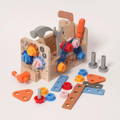
The Montessori Wooden Workshop is best for children who enjoy assembling recognisable models and having a dedicated place to build.

Its portable wooden toolbox flips over to become a stable workbench, while the handle remains attached. Children can use the 37 pieces to experiment with structures such as an airplane or windmill.
Montessori Wooden Workshop
Quick specifications:

Feature

Montessori Wooden Workshop

Recommended age

3+

Contents

37 wooden pieces

Standout feature

Toolbox converts into a workbench

Material

100% wood

Finish

Non-toxic, child-safe paint

Dimensions

8.5 x 5.1 x 5.2 inches

Weight

Approximately 37 oz

Care

Wipe clean and avoid prolonged moisture

The set includes:
  • A hammer, wrench, and screwdriver
  • Planks, wheels, and gears
  • Wooden screws, nuts, and nails
  • A toolbox that converts into a workbench
That build, dismantle, and rebuild cycle gives the activity staying power. Children can follow an idea, see the result, and then take everything apart before lunch because apparently the windmill was “not quite right.”

This is a bit better choice for a child who loves building specific objects and proudly displaying the finished result to every adult entering the house.

Montessori Wooden ToolBox: The Real-Tools Life-Skills Kit
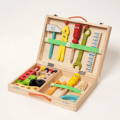
The Montessori Wooden ToolBox is best for children fascinated by fixing, tinkering, and working alongside an adult.

The set has the feel of a fuller toolkit, with one wooden case, eight tools, and 27 building parts. It gives children several ways to experiment while gently introducing the purpose of tools and the importance of using them carefully.
Montessori Wooden ToolBox
Quick specifications:

Feature

Montessori Wooden ToolBox

Recommended age

3+

Contents

1 case, 8 tools, and 27 building parts

Standout feature

Fuller toolkit for open-ended tinkering

Material

Eco-friendly wood

Finish

Non-toxic paint

Dimensions

11.4 x 8.3 x 2.4 inches

Weight

Approximately 32 oz

Care

Clean with a damp cloth and mild soap, then dry immediately

This set works particularly well for parent-child projects, sibling play, and children who enjoy pretending to repair household objects. It introduces practical life skills without handing a preschooler your actual power drill, which remains a sensible boundary.

Which Montessori Tool Set Should You Choose?

Choose the Wooden Workshop for structured model-building and the Wooden ToolBox for open-ended fixing, tool exploration, and shared projects.

Choose This Set

Best-Fit Child

Standout Feature

Play Style

Wooden Workshop

Loves constructing recognisable models

Flip-over workbench

Build, display, dismantle

Wooden ToolBox

Loves fixing and exploring different tools

8-tool kit with 27 parts

Tinker, repair, collaborate

Choose the Wooden Workshop if your child:
  • Likes building airplanes, windmills, and other models
  • Would enjoy having a small workbench
  • Prefers projects with a visible finished result
Choose the Wooden ToolBox if your child:
  • Is fascinated by real tools and household repairs
  • Enjoys open-ended tinkering
  • Likes building with parents, siblings, or friends

Both sets offer wooden construction, non-toxic finishes, fine motor practice, problem-solving, and purposeful play for ages three and older.

Buying for siblings or unable to choose? The sets complement each other. One provides the workbench, while the other expands the toolkit. Congratulations, your home now has a construction department.
Child using a wooden wrench and hammer to build a toy vehicle during hands-on play.

Is a Tool Set a Good Gift for Children?

Yes, a tool set is a meaningful gift for kids who like to help because it feels grown-up while supporting genuine developmental skills.

For a child who follows adults from job to job, receiving their own tools feels important. This is not simply another object placed on the toy shelf. It gives them a role, a purpose, and something they can learn to use with increasing independence.

A Montessori tool set works well for:
  • Third birthdays and later birthdays
  • Christmas and other holidays
  • Visits from grandparents
  • Rainy afternoons
  • Children welcoming a new sibling
  • Any weekend when an adult needs ten peaceful minutes
It is also a thoughtful option for relatives who want to buy something useful but are unsure what the child already owns. Grandparents can read more about choosing purposeful activities in this guide to Montessori for grandparents.

The best gift for kids who like to help is one that respects that interest. Wooden tools say, “You can join in,” which is much more meaningful than, “Here is another noisy object with seventeen buttons.”

How Can Parents Play Alongside a Little Builder?

Show one action slowly, then step back and give your child enough time to experiment independently.

A Montessori-style presentation does not require a formal lesson or a tiny clipboard. Keep it simple:
  1. Model one tool. Show how the wrench turns a nut or how two parts connect.
  2. Use few words. Let your child watch your hands without delivering a documentary.
  3. Pass the tool over. Give them time to repeat the action.
  4. Allow mistakes. A backward piece or crooked structure is part of the learning.
  5. Name what is happening. Say, “That is a wrench. You are turning the bolt.”
  6. Build together occasionally. Shared projects support conversation, cooperation, and happy memories, even when the result resembles a chair designed by a confused architect.
  7. Connect play to real life. Let your child observe or assist with a small, safe household task under close supervision.
Praise effort, focus, and persistence instead of testing your child or correcting every movement. Child-led learning in Montessori education gives children room to explore while the adult quietly provides safety, order, and guidance.
Child assembling colourful wooden nuts, bolts, and building pieces during hands-on play.

Hand Them the Hammer

A safe wooden tool set turns a child’s urge to copy grown-up work into concentration, practical skill, and well-earned confidence.

Choose the Montessori Wooden Workshop for the child who loves constructing models at a little workbench. Choose the Montessori Wooden ToolBox for the enthusiastic fixer who wants a fuller toolkit and plenty of open-ended tinkering.
Neither set needs flashing lights to hold attention. The attraction comes from the work itself: twisting, joining, testing, rebuilding, and finally announcing, “I did it!”

So, the next time your tiny shadow appears while you are fixing a hinge, they can arrive with wooden tools of their own. Your repair may still take twice as long, naturally, but you will have an extremely committed assistant.

Frequently Asked Questions

Why Are Toddlers and Preschoolers Obsessed With Tools?

Toddlers and preschoolers love tools because they naturally imitate meaningful adult activity. Tools represent a grown-up world they want to understand and join.

Are Toy Tool Sets Good for Children’s Development?

Yes, toy tool sets can develop fine motor control, hand-eye coordination, problem-solving, spatial awareness, patience, and confidence. The strongest sets require children to manipulate and connect pieces instead of merely pressing buttons.

What Age Is a Wooden Tool Set Suitable For?

The featured wooden tool sets are intended for children aged three and older. Parents should still supervise play and check whether the small pieces are appropriate for their individual child.

Is a Tool Set for Toddlers Safe?

A tool set for toddlers is safe only when it matches the manufacturer’s age guidance and is used with adult supervision. Choose smooth, child-safe wooden replicas, inspect the pieces regularly, and never confuse toy tools with real household tools.

Why Choose Wooden Tools Over Plastic Light-and-Sound Toys?

Wooden tools encourage active, hands-on play because children create the action themselves. They also support calm, screen-free concentration without lights, songs, or batteries directing the experience.

What Is the Difference Between the Wooden Workshop and Wooden ToolBox?

The Wooden Workshop has 37 pieces and a toolbox that becomes a workbench for model-building. The Wooden ToolBox contains eight tools and 27 building parts, making it better suited to open-ended fixing, tinkering, and collaborative projects.

  • Free Delivery

    Over $80
  • Easy Returns

    No questions asked
  • Unbeatable Warranty

    1-year ++ warranty

  • Secure Checkout
    World’s most secure payment method