


How to Help Toddlers Self-Regulate the Montessori Way
One minute, your toddler is happily playing at the park, the next, they're lying face down on the grass because it's time to leave. Yesterday, they wanted the blue cup. Today, the blue cup is apparently the worst thing that has ever happened to them. And if you've ever helped with a zipper they wanted to do themselves, you know how quickly good intentions can turn into a full-blown meltdown.
The good news? These big reactions are normal. A toddler's emotional system is still a work in progress, which means frustration, disappointment, excitement, and anger can spill out faster than they can manage.
Montessori self-regulation is about helping them slowly build the skills to handle big feelings through safety, repetition, independence, clear limits, and lots of practice.
A toddler cannot always calm down alone, but they can learn what calm feels like when an adult helps them get there. That is where toddler self-regulation begins.

What Self-Regulation Means for Toddlers
Toddler self-regulation is the ability to manage emotions, actions, and reactions. The important word here is learning.
For toddlers, self-regulation means slowly learning how to:
- Stop their body before acting
- Wait for a short time
- Handle small frustrations
- Use words instead of hitting
- Move from upset back to calm
- Accept simple limits
- Follow routines with support
That sounds simple, but it is a big job for a tiny human.
This is why Montessori self-regulation starts with realistic expectations. First, they need co-regulation, which means a calm adult helps them settle before they can learn to do it themselves.
Montessori approaches often support toddler emotional regulation through independence, practical life activities, prepared environments, freedom within limits, and adult modeling. Since a toddler’s emotional growth is slow, they need all the help they can get.
The Montessori Foundation: Freedom Within Limits
Yes, you’ve already heard a dramatic "NO!", and that’s the main reason Montessori talks so much about freedom within limits.
Toddlers want some control over their day. The problem is that they usually want control over everything.
Instead of fighting over every little thing, Montessori gives children small choices within firm boundaries.
Rather than: "Put your shoes on now."
Try: "It's time for shoes. Do you want the blue ones or the red ones?"
Instead of: "Stop making a mess."
Try: "Water stays in the bowl. You can pour here."
Instead of: "Don't run."
Try: "Walking feet inside. You can run outside."
The goal is to let them feel involved. When children have some say in what happens next, they're often less likely to fight every step of the process.
This balance between freedom and clear limits is a core part of Montessori practice and is often discussed by the American Montessori Society through concepts like the prepared environment and respectful guidance.
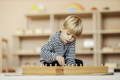
Trick 1: The “Pause Button” Game
One of the best ways to build toddler impulse control is to practice it when nobody is upset. A child in the middle of a meltdown is not thinking, "This would be a great time to learn self-control."
That's where the Pause Button Game comes in.
How to Teach it
Start by asking: "Let's find your pause button. Is it in your hand? Your tummy? Your knee?"
Once your child picks a spot, press the imaginary button together and make it part of the play.
Try things like:
- "Ready, set, pause!"
- "Run, run, run... pause!"
- "Clap, clap, clap... pause!"
- "Jump, jump, jump... pause!"
What it Teaches
Most toddlers think this is hilarious, which is exactly the point. They're practicing an important skill without realizing they're practicing it. Over time, the game helps children learn how to stop their body, wait, listen, and pay attention to what's happening around them.
When to Use it Later
Later, you can bring the same language into real-life situations:
Before crossing the street: "Pause button. Hold my hand."
Before grabbing a candy in the store: "Pause button. We wait."
Before throwing blocks: "Pause. Blocks are for building."
This is basically a workout. Every time your child presses that imaginary button, they're strengthening the self-regulation muscles they'll use later.

Trick 2: Stop-and-Go Games for Impulse Control
Toddlers are not wired to stop on command. That's why it helps to practice stopping when everyone is calm, happy, and having fun.
The good news? Most toddlers think impulse control is a game.
Freeze Dance
Put on some music and dance together. When the music stops, everyone freezes like a statue. Bonus points for silly poses.
Red Light, Green Light
This classic is simple for a reason.
Green light: Go!
Red light: Stop!
Start with walking, then level up to hopping, stomping, or tiptoeing.
Animal Pause
Mix movement with imagination:
- "Walk like a bear... pause!"
- "Hop like a frog... pause!"
- "Tiptoe like a mouse... pause!"
Simon Says
Keep it toddler-friendly:
- Touch your head
- Clap your hands
- Stomp your feet
- Sit down
- Stand up
These skills are closely linked to executive function, a group of mental skills that help children manage attention, behaviour, and self-control, according to the Harvard Center on the Developing Child.
And let's be honest, it's much easier to practice stopping during Freeze Dance than during a supermarket meltdown over a banana that broke in half.
Trick 3: Name the Feeling Without Removing the Boundary
One of the most useful Montessori tantrum tips is surprisingly simple: acknowledge the feeling without changing the rule.
A lot of us grew up hearing things like "You're fine" or "Stop crying." The problem is that feelings do not disappear just because we wish they would.
Instead, try this formula:
Name the feeling + state the limit + offer support.
When It's Time to Leave the Park
Leaving a fun activity is hard for most toddlers. The goal is not to convince them that leaving is exciting. The goal is to acknowledge the disappointment while keeping the plan.
"You are sad because we're leaving. The park is finished for today. I'll help you walk to the car."
When They Want More Snacks
Toddlers are often shocked to discover that crackers are not an unlimited resource. Instead of arguing, acknowledge the wish and offer an acceptable option.
"You really want more crackers. Crackers are finished. You can have water or a banana."
When Anger Turns Into Hitting
Feelings are okay. Hitting is not. Stay calm, stop the behaviour, and offer a safer way to express the feeling.
"You are angry. I will not let you hit. You can stomp your feet here."
When Toys Start Flying
Many toddlers throw when they're frustrated, excited, or simply curious about gravity. Keep the limit clear while redirecting the action.
"You are frustrated. Toys are not for throwing. You can throw this softball into the basket."
When You Accidentally Help Too Much
Every parent has zipped a jacket, poured the water, or stacked the blocks one second too soon. When independence is interrupted, frustration often follows.
"You wanted to do it yourself. That felt frustrating. I can wait while you try again."

Trick 4: Use Breathwork Toddlers Can Actually Understand
Telling a toddler to "calm down" rarely works. In fact, it often has the opposite effect. What works better? Showing them how to calm down.
The trick is to make breathing playful and practice it when your child is already calm, not when they're halfway through a meltdown.
Keep breathing simple and playful. Try saying, "Smell the flower. Blow the candle." Or, "Smell the hot cocoa. Blow it cool." Some children enjoy pretending they're blowing giant bubbles with a big breath in and a slow breath out.
Another favourite is placing a teddy bear on your child's tummy while they lie down and watching it slowly rise and fall as they breathe.
The key is to practice these games when your child is calm, not when they're already upset. Think of it as learning to swim before falling into the pool.
And during a meltdown?
Don't force breathing exercises. Instead, take slow, visible breaths yourself. Your child may join in, or they may simply borrow your calm for a moment.
The adult's calm body is often the first breathing lesson a toddler ever gets.
Trick 5: Create a Montessori Calm-Down Space, Not a Time-Out Corner
A Montessori calm-down corner is a place your child gets sent when they've had a bad moment. To enjoy some quiet time.
The goal is to create a small, safe space where your child can slow down, regroup, and reconnect with you. Most toddlers are not looking for isolation when they're overwhelmed. They're looking for safety.
You don't need anything fancy. A small pillow, soft blanket, favourite stuffed animal, a few books, an emotion card, textured ball, sensory bottle, or a small basket of calming objects is plenty.
What you don't need is a mini toy store. Skip the screens, noisy battery-powered toys, and anything that turns the space into another source of stimulation.
Most importantly, avoid language like: "Go sit there until you behave."
That turns the calm-down space into a punishment corner, which is the exact opposite of the goal.
Instead, introduce it with something simple: "This is your calm space. You can come here when your body feels too big. I can sit with you."
During a meltdown, try: "Your body is having a hard time. We can sit in the calm space together."
And after things settle: "You were very upset. You sat with me and your body got calmer."
The key is that your child should associate this space with support, not rejection. Whenever possible, it should feel like an invitation, not a sentence.

Trick 6: Use Visual Transitions to Prevent Meltdowns
Many toddler meltdowns happen during transitions. Not because your child is being difficult, but because toddlers don't experience time the way adults do.
To them, leaving the park can feel less like a transition and more like a surprise ending.
Visual cues help children see what's coming next.
A simple sand timer works well. Instead of saying, "We're leaving soon," try: "We will leave when the sand is finished."
You can also use first-then language: "First shoes, then outside" or "First clean up, then snack."
Another helpful trick is giving a countdown with a clear ending point:
- "Three more pushes on the swing, then we walk to the car."
- "One more trip down the slide, then we're going home."
The secret is giving your child a sense of completion. Most toddlers handle transitions better when they get to finish one last thing.
Try phrases like:
- "You may do one more scoop, then the water is finished."
- "You may put the doll in bed, then we will go to lunch."
- "You may choose one book for the car."
A small warning is often easier to accept than a sudden stop.
Trick 7: Give the Toddler a Job
Toddlers love feeling capable. They also love saying "I do it!" at least 37 times a day.
That's why practical life activities are such a big part of Montessori self-correction. When children feel included, they're often more cooperative and less likely to fight every step of the process.
At mealtimes, a toddler can carry napkins, put a spoon on the table, wipe up a small spill, or place their cup in the sink when they're finished.
Getting dressed offers plenty of opportunities, too. Let them choose between two shirts, put socks in the laundry basket, pull up their pants with help, or place their shoes by the door.
Cleanup becomes easier when it feels like a real responsibility. Toddlers can put blocks in a basket, wipe the table with a cloth, sweep with a child-sized broom, or water a plant.
Even errands can become a job. They can hold the shopping list, carry a light item, place fruit in a bag, or put an item on the checkout counter.
These tasks may seem small, but they're doing big work behind the scenes. Children are practicing concentration, patience, coordination, and responsibility.
Trick 8: Use Practical Life Activities to Build Focus and Control
A toddler can ignore you for ten minutes but suddenly become fully committed to wiping one tiny spill. Yeah, that's the magic of practical life activities.
These simple jobs help children slow down, focus, and practice self-control without even realizing it.
Pouring water is a great example. Give your child a small pitcher, a cup, and a towel for spills. Then try saying, "Pour slowly. Stop when the cup is full." It sounds simple, but they're learning patience and control with every pour.
Other activities work the same way:
- Transfer pom-poms with tongs to build focus and hand control.
- Wash a table by dipping a sponge, squeezing it, wiping, and drying.
- Sort laundry by matching socks or separating clothes.
- Arrange flowers in a small vase.
- Sweep the floor with a child-sized broom.
None of these activities is about keeping your toddler busy while you drink a coffee in peace (although that would be nice). They're helping your child practice slowing down, following steps, and finishing what they started.
Trick 9: Offer a Safe Physical Outlet
Sometimes, toddlers get so frustrated that sitting still is the last thing they want to do. The feeling is just too big.
In those moments, simply saying "Stop" isn't very helpful. A better approach is to keep the boundary but give your child something safe to do instead.
For example, if your toddler tries to hit you, you might say: "I won't let you hit me. You can hit this pillow."
Suppose blocks start flying across the room: "Blocks aren't for throwing. You can throw these soft balls into the basket."
If your child is screaming loud enough for the neighbours to check on you: "Wow, that's a loud voice. Let's roar like lions into this pillow."
If they're running laps around the kitchen: "Running is for outside. Inside, you can help me push this laundry basket."
And if kicking starts: "I won't let you kick me. You can stomp your feet right here."
The goal is to help your child learn a safer way to handle it.
Because let's be honest, frustration is part of life. Learning what to do with that frustration is the real skill.

Trick 10: Repair After the Storm
Once the meltdown is over, most toddlers don't need a lecture. Honestly, they probably stopped listening five minutes ago.
Instead, think of this as a quick "close the loop" moment. Keep it short. Keep it calm. Focus on what happened and what to do next time.
After hitting, you might say: "You were angry. I stopped your hands. Next time, you can say 'mine' or stomp your feet."
After throwing a cup: "You threw the cup. Cups are for drinking. Let's put it back."
After screaming: "That was a big feeling. You got through it. I stayed with you."
After refusing to clean up: "You were upset about cleaning. We cleaned together. Now it is done."
If someone was hurt or affected, help your child make a simple repair. That doesn't mean forcing a dramatic apology worthy of an awards ceremony.
Sometimes repair looks like:
- "Let's bring her toy back."
- "You can check if he's okay."
- "You can help me pick up the blocks."
The goal is to help them understand that actions have effects and that we can make things better when mistakes happen. That's responsibility. Shame doesn't teach it, but practice does.
What Not to Do During Toddler Meltdowns
When your toddler is having a meltdown, it's easy to fall into survival mode. We've all been there. The problem is that some common reactions can make the situation harder for both of you.
Try to avoid asking lots of questions like, "Why are you crying?" or "What's wrong?" In the middle of a meltdown, most toddlers don't know the answer themselves.
It's also not the best time for logic. A child who is overwhelmed isn't ready for a detailed explanation about why they can't have ice cream for breakfast.
Other things to avoid include:
- Threatening punishment
- Sending your child away as rejection
- Giving in to every demand just to stop the crying
- Saying, "You're fine"
- Calling your child bad, dramatic, manipulative, or naughty
- Expecting breathing tools to work without practice
- Changing the limit halfway through, unless safety is involved
The goal is not to be soft or strict. It's to be both supportive and clear. Your child needs connection and a boundary. Not only connection. Not only a boundary. A calm adult can say, "I am here" and "I will not let you hit" at the same time.
The CDC's positive parenting guidance for toddlers also encourages calm, consistent responses that help children learn appropriate behaviour over time.

How to Adapt by Age
To adapt by age, you need to know which activity helps when. A 14-month-old and a 4-year-old are dealing with very different challenges.
12-18 months:
Keep things simple. Focus on safety, redirection, and short phrases like "Gentle hands," "Feet on the floor," or "Cup stays on the table." At this age, movement and sensory activities are often more helpful than long explanations.
18-24 months:
This is a great time to start naming feelings and offering simple choices. Try things like, "You are mad. Stomp or hug?" or "Blue cup or green cup?" Small choices can prevent surprisingly big battles.
2-3 years:
Now you can introduce more structure. Sand timers, cleanup songs, practical life activities, calm-down spaces, and simple visual routines often work well. Many children at this age enjoy helping with pouring water, washing a table, or sorting laundry.
3-5 years:
Once the storm has passed, you can start reflecting together. Questions like, "What helped your body calm down?" or "What can we try next time?" help children think about their feelings and actions.
Progress often looks like shorter meltdowns, safer choices, quicker recovery, and a child who is more willing to accept help when they need it.
Montessori Toys Can Support the Process
No toy can teach self-regulation on its own. That comes from relationships, routines, practice, and a calm adult who shows up again and again.
That said, the right toys can create opportunities to build the skills behind self-regulation.
Simple Montessori toys for toddlers, such as sorting activities, stacking toys, fine motor tools, and other open-ended toys, encourage children to focus, slow down, and stick with a task. Unlike noisy toys that do all the work, these activities ask children to think, try, adjust, and try again.
For example, Montessori sensory toys help children practice concentration and patience. Montessori puzzle toys support hand control, coordination, and problem-solving.
Those small moments of practice often add up to big growth over time.
Conclusion
Montessori self-regulation grows through everyday moments. A toddler learns to pause by playing pause games. They learn patience by pouring water, sorting laundry, and helping around the house. They learn emotional language because adults name feelings again and again. And they learn calm by borrowing the calm of the people around them.
Some days will feel easy. Other days, your toddler may completely forget everything you've practiced. That's normal.
Progress is not a child who never melts down. Progress is a child who recovers a little faster, accepts help more often, or chooses a safer way to express a big feeling.
FAQs
Can toddlers really self-regulate?
Yes, but not the way adults do. Toddlers are still learning these skills and usually need adult support first. Over time, they gradually learn how to calm themselves, wait, and handle frustration.
What is Montessori self-regulation?
Montessori self-regulation helps children build self-control through independence, practical life activities, clear limits, routines, and respectful guidance.
What should I say when my toddler has a tantrum?
Keep it short and calm. Name the feeling, hold the boundary, and offer support. For example: "You are angry. I won't let you hit. I'm right here."
Is a Montessori calm-down corner the same as time-out?
No. A Montessori calm-down space is not a punishment. It is a safe place where a child can calm their body, often with support from an adult.
What activities help toddlers with impulse control?
Simple games like Freeze Dance, Red Light Green Light, and pause games work well. Practical life activities such as pouring water, sorting objects, cleaning spills, and sweeping can also help children practice focus and self-control.

Free Delivery
Over $80

Easy Returns
No questions asked

Unbeatable Warranty
1-year ++ warranty
 Secure CheckoutWorld’s most secure payment method