


Nature as the Classroom: Why Outdoor Exploration Matters in Montessori
Perhaps an ant is carrying something three times its size. Or a beetle has disappeared under a leaf. Whatever has captured the child’s attention, the rest of the world has temporarily been dismissed. Even snack negotiations may have to wait.
This deep concentration sits at the heart of Montessori nature exploration. In Montessori, the outdoors is one of the richest classrooms available, and admission is wonderfully free.
Nature gives children real textures, sounds, movements, smells, patterns, and problems to explore. It invites questions that do not come with neat answer cards. Why does that leaf float? Where is the worm going? Why is one side of the tree covered in moss?
These small discoveries support focus, curiosity, independence, movement, and respect for living things. They also offer something especially valuable in a screen-heavy world: a reason to slow down and look closely.
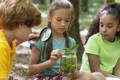
“Contact With Nature”: What Montessori Actually Believed
She wrote about giving children “contact with nature; to understand and appreciate the order, the harmony and the beauty in nature.” Nature was not a decorative extra squeezed in after the serious lessons. Nature was part of the serious lesson.
The Montessori approach to nature and outdoor play treats the outdoors as an extension of the prepared environment. Children should be able to explore natural spaces with the same freedom, purpose, and respect encouraged indoors.
This fits the broader Montessori principles of:
- Freedom within limits
- Purposeful activity
- Independence
- Respect for the environment
- Learning through real experiences
A child can feel rough bark, smell wet soil, hear birds calling, watch clouds move, and compare dozens of leaves during a single walk.
Outdoor discovery can be especially powerful during Montessori sensitive periods, when children become intensely interested in movement, language, order, sensory detail, or tiny objects.
What Children Actually Gain From Nature Exploration
These are not vague promises about fresh air. The benefits of outdoor play in Montessori education reach across physical, cognitive, social, and emotional development.
Here is what those benefits look like in everyday life:
Outdoor Experience
Skill Being Developed
Watching an insect move
Walking across uneven ground
Balance and coordination
Early maths and comparison
Caring for a plant
Responsibility and empathy
Drawing a discovery
Focus and Concentration
Children are more likely to concentrate when something genuinely interests them. A beetle does not flash, sing, or award digital coins. It simply gets on with being a beetle. The child must slow down and watch.
This matters because concentration is not built by repeatedly telling children to focus. It grows when they find something worth focusing on.
Curiosity and Scientific Thinking
A child observes something, develops an idea, tests it, and adjusts that idea according to what happens.
For example:
- Will this leaf float?
- Does the snail move faster on soil or stone?
- Are all the flowers in this patch the same?
- Why is the ground darker under the log?
- Which stick is the longest?
Patience and Emotional Regulation
A butterfly may fly away. A worm may hide. A bird may refuse to return until everyone stops discussing it at full volume.
Waiting for these moments encourages patience and self-control. Natural environments may also help children feel calmer, move more freely, and release some of the tension that builds during busy indoor routines.
Gross and Fine Motor Development
Children walk across uneven ground, balance on logs, crouch, reach, climb, dig, and carry objects. These movements build coordination and complement structured gross motor activities.
Nature also gives the hands plenty of careful work:
- Picking up a delicate leaf
- Holding a magnifying lens
- Using tweezers
- Turning an observation cup
- Measuring a stick
- Drawing in a journal
Care, Empathy, and Stewardship
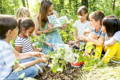
When a child carefully studies a small creature and returns it to where it was found, responsibility becomes real. “Be kind to nature” is no longer an abstract instruction. It becomes something the child can practise.
The lesson is simple:
- Observe it.
- Handle it gently.
- Return it safely.
- Leave its home as you found it.
Independence and Confidence
The adult did not reveal the answer with dramatic teacher energy. The child looked, wondered, and discovered something independently. Those small moments help build genuine confidence.
The Screen-Time Problem and Why Nature Is the Antidote
According to the National Wildlife Federation, the average American child may spend only around 30 minutes a day in unstructured outdoor play while spending more than seven hours using electronic screens.
These are broad figures, not a personal verdict on every family. Still, the imbalance deserves attention.
Author Richard Louv described the growing separation between children and the natural world as nature deficit disorder. He introduced the term in his 2005 book, Last Child in the Woods.
Nature deficit disorder is not a medical diagnosis. It describes concerns about what children may miss when outdoor experiences are replaced by indoor, scheduled, and screen-based activities.
Technology has a place in family life, and guilt rarely creates a workable routine.
A better approach is to make outdoor time interesting. Parents trying to balance children and screen time can offer a simple mission:
- “Find three different leaf shapes.”
- “Look for signs that birds have visited.”
- “Follow an ant without touching it.”
- “Measure the longest stick you can find.”
From Looking to Investigating: The Montessori Difference
A child might glance at a butterfly and continue walking. They could also follow it, observe where it lands, inspect its colours through a lens, draw it, and compare it with another butterfly later.
The second experience involves sustained attention and active thinking. That is hands-on nature learning rather than simple outdoor sightseeing.
Real tools strengthen the experience. A ruler, compass, net, observation cup, or magnifying lens gives the child purposeful work.
Tool
What the Child Can Do
Magnifying lens
Compass
Explore directions and orientation
Pick up small objects with control
Observation cup
Study a creature briefly and safely
Nature journal
Of course, adults still set sensible boundaries. Child-led learning does not mean allowing a preschooler to disappear into the woods because the compass “said north.”
Child-led learning in Montessori education gives children meaningful choices within a safe, prepared environment.
The same idea appears in the science behind Montessori toys. A useful material does not perform all the interesting work for the child. It invites action, repetition, problem-solving, and discovery.
Montessori Nature Activities You Can Do This Week
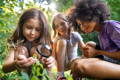
Nature activities for kids do not require an enormous forest or a parent who can identify every beetle by its middle name. Start with what is available and follow the child’s interest.
Try a Slow Bug Watch
- How it moves
- Where it goes
- What it touches
- Whether it stops
- How its body looks
Study a Square of Earth
Look for plants, stones, insects, seeds, feathers, roots, or differences in the soil. Return to the same square after a few days and see what has changed.
A tiny piece of ground can hold an outrageous amount of preschool drama.
Catch, Observe, and Release
Keep the rules clear:
- Use slow, gentle movements
- Never shake the container
- Do not touch unfamiliar insects
- Keep the observation brief
- Release every creature promptly
- Wash hands afterwards
Measure the World
Children can measure leaves, sticks, flowers, stones, pinecones, and footprints.
Ask which object is longer, shorter, wider, or narrower. This turns early maths into something the child can see and touch.
Keep a Nature Journal
The goal is to preserve observations, not judge whether the ladybird looks anatomically convincing.
Follow a Direction
This activity supports orientation and develops early spatial awareness. Keep the exploration within a familiar, safe space. You are teaching directions, not preparing the child for a solo expedition.
Explore Water Outdoors
Children can investigate which objects:
- Sink
- Float
- Absorb water
- Change colour
- Become softer
- Move with the current
It also confirms that children can find serious educational value in making both sleeves wet.
For every activity, follow the Montessori posture. Let the child choose what deserves attention. Name unfamiliar objects when helpful, but do not dominate the investigation. The adult prepares the opportunity. The child supplies the curiosity.
The Tools That Turn a Walk Into an Expedition
Children can enjoy nature on their own, so extra tools are not needed that much. However, useful tools can make exploration easier to begin and give the child genuine responsibility.
There comes the Montessori Nature Explorer Kit. This is an eight-piece set designed for independent, screen-free discovery.
The set includes:
- A ventilated bug observation house with built-in magnifying lenses
- A telescopic butterfly net
- An insect catcher
- An observation cup
- A wooden hand lens
- A wooden ruler
- Tweezers
- A compass
They can also use the tools to:
- Inspect tree bark
- Compare leaves
- Measure sticks
- Examine stones
- Look for tracks
- Practise direction games
- Record discoveries
The supplied specifications list it for children aged three and older. It measures 8.7 by 5.1 by 4.9 inches, weighs 26.5 ounces, and uses oak wood and child-safe plastic.
Wipe the pieces clean and avoid prolonged exposure to moisture. Adults should supervise children around living creatures, teach gentle handling, and make sure every animal is released promptly where it was found.
A Gift That Gets Them Off the Screen and Into the Grass
It can work for birthdays, holidays, visits from grandparents, or the highly underrated celebration known as “just a Tuesday.”
Unlike a gift that performs once and then starts collecting dust with great commitment, exploration tools can support a different experience every time a child goes outside.
- Active
- Educational
- Reusable
- Screen-free
- Suitable for independent exploration
- Open-ended rather than prescriptive
The best gifts do more than occupy a child. They invite movement, thought, questions, and another trip outside.
How to Support, Not Direct, Your Young Explorer
Follow your child’s attention first. If you planned to study leaves but your child has become deeply invested in one determined snail, congratulations. The snail is now the curriculum.
Ask open questions such as:
- “What do you notice?”
- “What do you think it is doing?”
- “What changed since yesterday?”
- “How are these two objects different?”
- “How could we find out?”
Use specific language when it helps. Words such as antennae, stem, smooth, rough, beneath, longer, and beside build vocabulary naturally.
A ruler creates opportunities to discuss numbers and comparison. A compass introduces direction. A nature journal connects observation with language and memory.
Most importantly, model careful treatment of living things. Children learn stewardship by watching adults behave respectfully, even when the creature being observed has far too many legs for anyone’s comfort.

Let Them Get Quiet in the Grass
Outdoor discovery can strengthen attention, curiosity, coordination, emotional balance, scientific thinking, and respect for the environment. In a screen-heavy world, giving children a meaningful reason to step outside is one of the simplest ways to rebuild that connection.
It does not need to be elaborate. A garden, a magnifying lens, a small patch of earth, and enough time to look closely may be all it takes.
Then comes that wonderful moment again. A child crouches in the grass, becomes completely still, and forgets everything except the tiny world in front of them.
That is not wasted time. That is the serious work of wonder.
Frequently Asked Questions
Why Is Nature Important in Montessori Education?
What Did Maria Montessori Say About Nature?
Maria Montessori believed children needed direct contact with nature to understand and appreciate its order, harmony, and beauty. She treated outdoor access as an important part of education, not a reward offered after academic work.
What Is Nature Deficit Disorder?
Nature deficit disorder is Richard Louv’s term for the problems associated with children spending too little time in nature. He introduced the term in Last Child in the Woods in 2005. It is not a medical diagnosis.
What Are the Benefits of Outdoor Play for Children?
At What Age Can Children Start Nature Exploration?
Children can start nature exploration during babyhood through supervised walks, outdoor sensory experiences, and simple observation. Tools such as magnifying lenses, rulers, nets, and observation containers generally suit children from around age three.
How Can I Do Montessori Nature Activities at Home?
You can do Montessori nature activities at home by observing one creature, studying a patch of ground, measuring natural objects, keeping a nature journal, or practising gentle catch-observe-release.

Free Delivery
Over $80

Easy Returns
No questions asked

Unbeatable Warranty
1-year ++ warranty
 Secure CheckoutWorld’s most secure payment method