


How to Set Up a Montessori Nursery in Your Home for Newborns and Toddlers
Most traditional nurseries are cluttered, overstimulating, and designed more for adults than for babies. On the other hand, a Montessori nursery іs calm, purposeful, and built entirely around the child’s needs. It’s not about expensive furniture оr trendy minimalism, it’s about developmental science.
The first three years are critical for brain development. The environment during this time directly shapes a child’s ability tо move, focus, and grow.
A well-designed nursery room that follows the Montessori method actually encourages independence, natural exploration, and self-directed learning from birth.
So yeah, you’ll have an environment that follows Montessori principles and gives babies a chance to start engaging with their space independently. Let’s see how to create a Montessori nursery the right way.
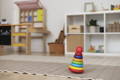
Understanding Montessori Nursery Philosophy
Creating a Montessori nursery starts with a mindset. Every design choice stems from a deeper belief that the child іs capable, and the environment should support their independence from day one.
Montessori environments are built оn observation, intention, and respect. The baby isn’t a passive recipient оf stimulation but an active participant іn learning. This means everything іn the nursery іs placed and chosen with purpose.
The goal is to make the space feel safe, accessible, and inviting, so the child begins to understand: “I belong here. I can do things on my own.”
The Science Behind Montessori Environments
In those first three years, your baby’s brain is working overtime, building 85% of its structure and cranking out millions of new neural connections every second. So yeah, the nursery isn’t just where they nap. It’s where their future is being wired.
That’s why a Montessori setup feels so intentional. Here, you’ll see low shelves and peaceful, clutter-free zones that invite your little one to explore, touch, move, and grow, without getting overwhelmed.
Also, when babies are in a space that’s calm and well-organized, they absorb and process the world more smoothly. Soft lighting? Yes. Muted colors? Absolutely. Freedom to move safely? Non-negotiable.
Sure, nurturing a Montessori baby takes some effort. But the payoff? Instead of swiping screens, they’re working with real stuff. Exploring. Thinking. Becoming confident, curious little humans who are wired for lifelong learning.
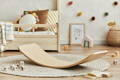
Core Montessori Principles for Nurseries
Montessori nurseries bring five foundational principles to life in a practical way:
1. Respect for the child
From the very beginning, a Montessori nursery respects the infant’s autonomy. This means using real, functional furniture at their level, no fake play kitchens or oversized décor. Everything is made accessible so the baby can begin interacting with their world meaningfully.
2. The prepared environment
A hallmark of Montessori design is intentionality. Every object has a purpose and a place. In a prepared environment, beauty and function come together to teach order and trust in the environment.
3. The absorbent mind (0–6 years)
Maria Montessori believed that during early childhood, children absorb information from their environment effortlessly. The nursery, therefore, must be rich in sensory detail, with a focus on real-life experiences.

4. Sensitive periods
Young children go through specific developmental windows where they are uniquely sensitive to order, movement, and language. These are what’s known as sensitive periods.
For example, from birth to age 4, children crave order. A well-organized nursery supports this innate need and can deeply affect how safe and grounded a baby feels.
5. Auto-education
Montessori believed children educate themselves when placed in a supportive, well-prepared space. This idea, that the environment is a teacher, drives the minimalist, intentional, and natural nursery design.

Montessori vs. Traditional Nursery Comparison
Ever wondered why a Montessori nursery feels so different? It’s because of the mindset.
Traditional baby rooms? Built for adults. Pretty, polished, and all about convenience.
Montessori nurseries? Built for babies. Every detail supports independence, movement, and real exploration from the start.
Here’s how that plays out in real life:
Aspect
Traditional Nursery
Montessori Nursery
Sleeping
Crib with bars
Floor bed or low mattress for independent access
Storage
Tall dressers and closed cabinets
Low open shelving that a child can reach
Toys
Overflowing bins and shelves
Curated and rotated selection of developmentally appropriate items
Decoration
Designed at adult eye-level
Art, mirrors, and visuals placed at the child’s eye level (12–18")
Colors
Bright themes and busy patterns
Neutral tones with soft, calming accents
Materials
Plastic toys and synthetic fabrics
Natural woods, cotton, wool, and other sensory-rich materials
Organization
Hidden or chaotic storage
Visible, consistent layout with a place for everything
Pre-Planning Your Montessori Nursery
A true Montessori nursery starts with planning. You need to understand your space, your budget, and your child’s developmental needs.
This is where Montessori’s respect for the environment as a “second teacher” really comes into focus.
Room Selection and Assessment
Start by evaluating which room in your home makes the most sense. Ideally, you want a space that’s at least 8x10 feet to allow for movement, play, and sleep zones.
Look for good natural light; south or east-facing windows are ideal, and prioritize rooms with minimal ambient noise and good ventilation.
Use this checklist:
- Does the room have enough floor space for distinct areas (sleep, care, movement, feeding)?
- Can you control lighting naturally and artificially?
- Is the room easy to navigate for both baby and caregiver?
- Are there safety hazards like sharp corners, loose outlets, or cords?
Budget Planning and Investment Strategy
You don’t need designer furniture to do it right. Most parents get creative, mixing secondhand gems, DIY hacks, and a few smart buys. And it doesn’t matter if your budget’s $500 or $3,000+, you can still build a space that’s calm, simple, and made for real baby growth.
Start with the must-haves:
A floor bed, a low shelf, a safe spot to move around, and basic safety gear. That’s your solid foundation.
Here’s how the budget might break down:
- $500–$800: Think floor mattress, a low shelf, a safety mirror, and a cozy mat.
- $800–$1,500: Upgrade with a wooden bed frame, kid-sized table and chair, and some natural toys.
- $1,500–$3,000+: Want to go big? Custom furniture, full toy rotation, even design advice, it’s all on the table.
Room Layout Planning System
A Montessori nursery is intentionally divided into four areas that support development through movement, exploration, and care. Designate room zones in this ratio:
The most noticeable benefits of this toy:
- Sleep Area (25%): Floor bed against the wall, perhaps next to a low shelf with a few books.
- Movement Area (35%): Open rug or mat with a mirror, pull-up bar, or space to crawl and roll.
- Feeding/Calm Area (25%): A nursing chair now, a weaning table and reading nook later.
- Care Area (15%): Diaper station, organized clothing storage, and access to grooming tools.
This balance allows the room to work as a full-time environment, not just a place for naps.
Essential Furniture and Equipment Guide
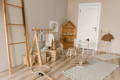
A Montessori nursery room is built for the child, not the adult. That means choosing furniture that fosters independence, mobility, and exploration from day one. And you don’t need a room full of items, just a few key pieces designed with intention.
The Montessori Floor Bed System
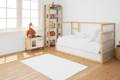
A floor bed is the centerpiece of any Montessori nursery. Unlike a crib, it gives the child freedom of movement and control over when they sleep and wake. That freedom supports early autonomy, body awareness, and self-regulation.
The floor bed isn’t just a trend; it’s a tool for brain development. When babies can move in and out of bed on their own, they start understanding boundaries and building independence naturally.
Benefits:
- No physical barriers to exploration
- Encourages safe, confident mobility
- Respects the child’s natural sleep cycle
Options by budget:
- Budget ($50–150): Firm mattress on the floor with a simple wooden frame, maybe even a DIY one that meets all the safety considerations and setup requirements.
- Mid-range ($200–500): Purpose-built Montessori floor beds with rounded edges and integrated safety features made from untreated wood.
- Premium ($500–1,000+): Custom pieces with heirloom quality construction and features like rail guards or under-bed storage.
Safety prep includes:
- Full room baby-proofing.
- Outlet covers, anchored furniture, and padded edges.
- Monitoring systems, if needed, during early use.
Storage and Organization Systems
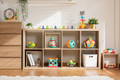
Montessori nursery furniture needs to have a purpose. Low, open shelving invites the baby to make independent choices. Toys and materials are visible, accessible, and neatly arranged in baskets or trays.
Low shelf guidelines:
- Max height: 24–30 inches.
- Natural wood preferred (unfinished or safely sealed).
- One item per basket to reduce overwhelm.
You can find beautifully made Montessori nursery shelves through custom woodworking shops or curated retailers, or repurpose existing shelves with a child-safe finish.
Child-Sized Furniture Integration
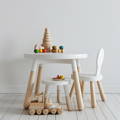
The nursery evolves as your baby grows. Around 8 to 12 months, you can introduce a weaning table and a small chair. This is where your baby will eat, explore activities, and begin learning seated independence.
Key furniture pieces:
- Weaning table & chair set: Short enough for the child to sit with feet flat on the floor.
- Pull-up bar & mirror: Mounted horizontally at baby chest height for cruising.
- Balance & climbing tools: Soft climbers or wooden triangles for 12–24 months.
Creating the Optimal Environment
A true Montessori nursery setup is connected to how the entire space feels to the child. Everything from color to light to materials should serve a developmental purpose. This is where the philosophy comes to life in design.
Color Psychology and Visual Environment
Montessori nursery decor sticks to soft colors and natural materials, not just to look cute, but because it actually helps. Research shows that babies can get overstimulated easily, and too many bright colors or busy patterns can stress them out instead of keeping them engaged.
Color setup tips:
- Base (70%): Soft neutrals like ivory, oatmeal, or light wood.
- Natural accents (20%): Greenery, woodgrain, cotton textures.
- Minimal brights (10%): A single bold color in a mobile or toy bin.
Keep visual elements at baby's eye level (12–18 inches) to align with developmental needs.
Lighting Design for Development
Light influences everything from sleep to sensory regulation. Your Montessori baby room design should maximize natural light while giving you full control of brightness.
Natural light guidelines:
- Use soft-filtering curtains or adjustable shades.
- Orient the sleep and movement areas away from direct glare.
- Adjust lighting seasonally to maintain a consistent rhythm.
Safety tip: All lighting fixtures should be secure, cool-to-touch, and cord-free within the child’s reach zone.
Natural Materials Integration
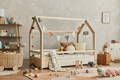
A Montessori nursery should feel like a slice of the natural world. From the wood beneath their hands to the cotton they snuggle against, babies learn through texture and contact with real materials.
Why it matters:
- Stimulates sensory development.
- Builds early environmental appreciation.
- Supports safe, non-toxic exploration.
Ideally, you should use wool, bamboo, organic cotton, and wood wherever possible. These materials are not only safer but also more enduring and beautiful.
Material guidelines:
- Wood: Choose sustainably sourced, unfinished, or food-safe sealed
- Textiles: Look for GOTS-certified organic cotton and wool
- Metal: Minimal use, only if rounded and non-toxic
- Stone/ceramic: Add later (18 months+) with safe, non-breakable items
Age-Specific Adaptations and Growth Planning
A Montessori nursery isn’t static; іt evolves with your little one, and the environment needs tо shift tо meet developmental needs while continuing tо support independence.
Newborn to 6 Months: Foundation Stage
A Montessori baby room design is to provide comfort, visual stimulation, and it should be a safe space for movement.
Essential elements:
- Use high-contrast materials that support tracking and focus to help your baby with visual development.
- Tummy time is also key for building core strength and coordination, so a soft but firm movement area is essential.
- Sensory exploration through natural fabrics, varied textures, and uncluttered surroundings encourages early cognitive growth.
You can read more about how visual learning begins in infancy in this Montessori newborn visual guide.
Room configuration:
Make sure the nursery layout supports parental needs, too, especially during nighttime wake-ups. Clear, hazard-free paths and good lighting help ensure a calm environment.
The baby’s space should be minimal but not sterile. Safe, open, and designed with future movement in mind.
Specific products and setup:
- Mobiles: Use the Montessori progression, Munari, Octahedron, Gobbi, and Dancers, changing each as your baby’s vision sharpens.
- Movement mats: Choose natural fiber rugs or mats that allow your baby to move freely and safely.
- Storage: Open bins or baskets make frequent diaper changes and clothing shifts easier and more organized.

6–12 Months: Exploration Stage
Your little one’s on the move, chatting up a storm, and wanting to do things all by themselves. The nursery needs to keep up.
What’s changing?
Once they start walking, you’ll need sturdier furniture that actually makes sense for their new skills. A low floor bed still works great; it lets them move freely and crash when they’re tired.
They’re also soaking up language like crazy, so keep the books, songs, and chats coming.
How should the room evolve?
Bring in a small table and chair for snacks, scribbles, and play. Rotate toys to keep things interesting, out with the baby stuff, in with new challenges.
And don’t forget to do another safety sweep. Toddlers climb everything.
What to add now:
- A tiny broom or sponge so they can “help” clean
- An art station with paper and washable paint
- A forward-facing bookshelf to encourage solo reading
Need toy ideas? Our Montessori toys collection for babies 0–12 months is a solid place to start.

12–24 Months: Independence Stage
This stage brings rapid growth in mobility, communication, and independence. Your nursery should support this transition.
Major developmental shifts:
As walking emerges, furniture must become sturdier and more purposeful. A low Montessori floor bed nursery setup continues to offer freedom of movement and self-directed sleep habits.
You’ll also notice a language explosion, which means your baby needs books, songs, and conversations to nurture vocabulary and connection.
Room evolution:
Now’s the time to introduce a child-sized table and chair for meals, crafts, and learning. Toy rotation should become more complex, offering new challenges and removing items that are too simple.
Reassess safety often because toddlers are strong, curious, and capable of climbing and reaching new places.
For developmentally aligned toy options, visit the Montessori toys for 1-year-olds collection.
Advanced elements:
- Practical life activities like child-safe cleaning tools help toddlers feel useful and build self-reliance.
- An art station stocked with paper, crayons, and washable paint promotes creativity and self-expression.
- A book corner with a forward-facing shelf invites independent reading and language development. See the life skills toys collection for child-accessible options.

24–36 Months: Mastery Stage
Now your toddler is entering what Montessori called a period of refinement and mastery. The space should reflect this growth.
Developmental capabilities:
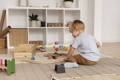
Cognitive development takes center stage as children begin tackling puzzles, building structures, and engaging іn pretend play.
Social growth also blooms, and sharing, turn-taking, and understanding rules all start at this time. Self-care becomes a new frontier: putting оn shoes, brushing teeth, and dressing independently.
Final room configuration:
- Advanced organization: Bins labeled with pictures and categories let the child manage their own materials
- Responsibility areas: A basket for laundry, a cloth for spills. These items promote accountability.
- Learning stations: A designated area for puzzles, blocks, or matching games encourages focus and problem-solving
Safety Protocols by Developmental Stage
No matter how peaceful or beautiful a Montessori nursery looks, it must first and always be safe. A baby Montessori environment gives your child freedom, but freedom only works when it’s built on a secure foundation.
Universal Safety Principles
Let’s get into the most important safety measures that are non-negotiable and apply tо all Montessori nursery rooms:
- Anchor everything: Shelves, mirrors, dressers, if it stands tall, it gets secured to the wall.
- Cover outlets: Always. Use cord clips to keep cables tucked away.
- Secure windows: Go cordless with blinds, install guards or latches to prevent accidents.
- Pad sharp corners: Even with rounded furniture, cushion any exposed edges, especially once your little one’s on the move.
Stage-Specific Safety Protocols
As your child grows, new abilities bring new risks and new adjustments to the room.
Newborns (0–6 Months):
- Sleep smart: Firm mattress, fitted sheet only, no pillows, bumpers, or blankets.
- Supervise floor time: Even in a baby-proofed room.
- Stay comfy & safe: Keep temp steady, no loose cords. Use a sleep sack for warmth.
Mobile Babies (6–12 Months):
- Baby-proof more: Lock drawers and cabinets.
- Safe floors: Use non-slip rugs and mats.
- Watch for small stuff: Limit clutter and rotate toys to avoid choking hazards.
Toddlers (12+ Months):
- Mobility-proof everything: If it can be climbed, it had better be safe.
- Safe freedom: Block off stairs, but keep the room open for exploring.
- Plan: Check smoke alarms, clear exits, and post emergency contacts.

Common Challenges
From small spaces tо tight budgets tо resistant toddlers, many parents hit roadblocks when designing a Montessori nursery. Luckily, there’s always a Montessori-aligned solution that keeps your baby’s needs and development front and center.
Space Limitation Solutions
Montessori nursery room design doesn't require a sprawling space; it requires smart use of what you have.
Small rooms:
- Use multi-use pieces like a floor bed with storage or a weaning table for play.
- Wall shelves equal toy access without floor clutter.
- Define zones (sleep, play, care) with rugs or lighting.
Shared spaces:
- In a parent’s room? Use low shelves or partitions to mark the baby’s area.
- Sharing with siblings? Create separate zones based on each child’s age.
- In an open-plan home? A cozy corner with a floor bed, mirror, and shelves works great.
Budget Constraint Solutions
You don’t need a designer nursery to follow Montessori principles. Montessori nursery decor and furniture can be affordable with the right strategy.
DIY priorities:
- Build a simple Montessori floor bed frame, or skip the frame and use a mattress directly on the floor with a breathable rug underneath.
- Construct basic low shelves with unfinished wood or repurpose old bookshelves, and cut to child height.
- Use a mirror from a secondhand store mounted horizontally at floor level for movement and visual tracking.
Budget phases:
- Phase 1: Sleep space, safety-proofing, and basic shelving.
- Phase 2: Add movement area elements like a pull-up bar and simple toys.
- Phase 3: Layer in Montessori nursery furniture like a child-sized table, weaning chair, and additional shelves for rotated materials.
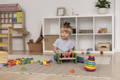
Child Resistance and Adaptation Issues
Montessori nursery setup supports a child’s natural rhythms, but not every child transitions easily. Resistance is normal, and how you respond matters.
Common issues:
- Floor bed resistance: Some children may cry or get up frequently. The solution? Consistency and patience. Offer reassurance, but don’t revert to confinement-based sleeping.
- Disorganized space: Children won’t maintain order without being taught how. Label baskets with pictures, model cleanup slowly, and use consistent routines.
- Overwhelmed by toy rotation: Too many changes at once can be destabilizing. Instead, rotate one or two materials weekly and keep a consistent core group visible.
Adaptation tips:
- Adjust the environment for sensory sensitivities and use softer textures, warmer light, or calming scents.
- For children with developmental delays, extend timelines and simplify setup. The principles still apply; they just need personal calibration.
- Blend Montessori with your family’s culture. Integrate traditional décor, stories, and activities that honor your values while staying child-centered.
Advanced Montessori Integration
Creating a Montessori is the start of a larger shift in how your home supports your child’s growth. As your baby develops, the goal is to weave Montessori values beyond their nursery walls and into the rhythm of everyday life.
Connecting Nursery to Whole-Home Montessori
A well-prepared Montessori baby room lays the groundwork for independence, but consistency throughout your home reinforces those habits.
Create continuity:
- Extend low shelving, natural materials, and accessible tools into other rooms like kitchen stools, step stools in the bathroom, and low hooks for coats.
- Involve siblings and family members. A toddler setting the table while their infant sibling watches from a safe space? That’s Montessori family life in action.
- Connect nursery tasks to practical life skills: wiping up spills, brushing teeth, and choosing clothes.

Seasonal and Cultural Adaptations
Your child’s environment should evolve with the rhythms of life and reflect the values of your home.
Seasonal changes:
- Rotate in natural elements like pinecones in winter, flowers in spring, or seashells in summer.
- Swap out books and music to reflect seasonal holidays, weather, and celebrations.
- Adjust lighting, textures, and activity levels to match energy cycles throughout the year.
Cultural integration:
- Decorate with meaningful items: family heirlooms, traditional fabrics, or images from your heritage.
- Incorporate cultural tools and materials into their Montessori shelves, musical instruments, language cards, or traditional food prep tools.
- Celebrate cultural holidays with real-life, age-appropriate involvement: preparing food, setting the table, decorating.
Technology Integration Guidelines
Montessori environments are designed to support concentration, movement, and real-world interaction, none of which a screen provides to an infant.
To keep the space screen-free:
- Offer sensory-rich alternatives like rattles, musical instruments, mirrors, and textured baskets.
- If you must include tech, delay introduction as long as possible and ensure it’s high-quality, intentional, and parent-involved.
- Set clear family media policies so the nursery remains a space of quiet, uninterrupted exploration.

Long-Term Planning and Evolution
A well-designed Montessori nursery doesn’t stay static. It’s built tо grow alongside your child, transforming іn response tо their changing physical, cognitive, and emotional needs.
Transition Planning
As your baby becomes a toddler, and your toddler becomes a confident preschooler, their environment must shift to meet new challenges and developmental milestones.
Key transitions to expect:
- Floor bed to toddler bed: While many children stay with a Montessori floor bed until age 3 or beyond, you might upgrade when they begin needing more space or show readiness for a frame with side rails.
- Shelving to activity zones: Early on, a few low shelves suffice. Later, you might develop more distinct learning stations for art, practical life, or reading.
- Toys to tools: What begins as sensory play transforms into practical life work, and you can achieve this with things like cleaning supplies, cooking utensils, and dressing aids.
Plan your Montessori bedroom setup so pieces can shift roles over time. A mirror for tummy time today might become part of a dressing station tomorrow. Flexibility is key.
Investment Protection
Creating a Montessori nursery room involves both time and money, but that doesn’t mean you need to buy everything new, or all at once.
Know what to invest in:
- Heirloom pieces: These include your floor bed, solid wood shelving, or a child-sized table and chair. High-quality pieces made from natural wood will last through multiple children and resell well.
- Temporary elements: Mobiles, weaning table accessories, or infant rattles don’t need to break the bank. Prioritize safety and function, but accept that these will be phased out.
- Convertible pieces: Look for furniture that evolves, shelves that can be rotated, tables that adjust in height, or beds that double as reading nooks later.

Conclusion
A Montessori nursery is all about giving your child the freedom to grow, explore, and learn from day one. Simple choices, like a floor bed, low shelves, and natural materials, support independence right from the start.
The space should grow with your child. It doesn’t need to be perfect, just responsive. What matters most is your intention. Start with the basics, trust your child’s abilities, and adjust as they grow.
With a thoughtful setup, you’re creating a space that supports lifelong learning. And, if you have any Montessori nursery ideas that we didn’t cover, feel free to let us know.

Free Delivery
Over $80

Easy Returns
No questions asked

Unbeatable Warranty
1-year ++ warranty
 Secure CheckoutWorld’s most secure payment method